
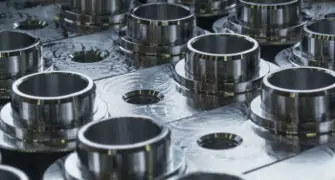



5-axis CNC Machining Services
Anxin provides you with high-quality products with five-axis machinery. Five-axis machining is a high-precision CNC machining technology that enables a cutting tool to move along five different axes simultaneously. It allows for machining complex 3D parts from multiple angles in a single setup, significantly reducing setup times and improving machining accuracy.
ISO 9001:2015
How It Works: The Data-Powered Manufacturing Process
Design & Programming: Create a 3D model of the part using CAD software, then convert it into a machine-readable G-code program via CAM software, defining the 5-axis movement paths and cutting parameters.
Workpiece Setup & Fixturing: Secure the raw material onto the machine’s worktable with appropriate fixtures, ensuring stability and alignment to avoid displacement during multi-axis cutting.
Tool Selection & Loading: Choose cutting tools matching the workpiece material (e.g., carbide end mills for metals, diamond tools for composites) and load them into the machine’s tool magazine.
Machine Calibration & Simulation: Calibrate the machine’s axes to ensure precision, then run a virtual simulation of the machining process to check for tool collisions or path errors.
Multi-Axis Machining Execution: Start the machine; the cutting tool and workpiece move simultaneously along X, Y, Z linear axes plus two rotary axes, shaping complex geometries in a single setup.
Post-Machining Inspection: Unload the finished part and perform dimensional inspection with tools like CMMs (Coordinate Measuring Machines) to verify compliance with design specifications.
Mechanical Structure of 5-axis CNC Machine
A. Two rotating coordinates directly control the direction of the tool axis (Double Swing Head Type)
B. Two coordinate axes are at the top of the tool, but the rotating axis is not perpendicular to the linear axis (Pitch Type Swing Head Type)
C. The two rotating coordinates directly control the rotation of the space (Double Turntable Form)
D. the two coordinate axes are on the worktable, but the rotating axis is not perpendicular to the linear axis (Pitching Worktable Type)
E. The two rotating coordinates act on the tool one at a time Up, one acting on the products. (One Swing and One Revolving Form)
5-Axis CNC Machining Principle
1. 5-axis machining enables simultaneous movement of the cutting tool or workpiece along three linear axes (X, Y, Z) and two rotary axes, allowing access to complex part geometries from multiple angles in a single setup.
2. By eliminating the need for repeated re-fixturing, this technology minimizes positioning errors and significantly improves the dimensional accuracy and surface finish of machined components.
3. CAM software generates precise toolpath instructions based on 3D part models, coordinating the synchronized motion of all five axes to achieve efficient and high-quality machining of intricate parts.
Core Advantages: Why It’s Choosen as the Best Machining Process now?
Suitable for processing complex and irregular parts: Widely used in aerospace, shipbuilding, mold and other processing industries as they can process complex parts that are difficult or almost impossible to process with ordinary machining centers.
High machining accuracy: Perform complete dimensional analysis of materials through five axis positioning machining.
Stability: Realize computer mastery, eliminate human error, ensure good consistency in part processing, and ensure stable and reliable quality.
High flexibility: When the processing object changes, it is generally only necessary to change the CNC sequence, demonstrating good adaptability and greatly saving production preparation time.
High productivity: The productivity of the five axis machining center is high, generally 3-5 times that of a regular machining center, and can handle the processing of certain complex parts.

Why choose us for 5-axis CNC Machining?
1. High Precision for Complex Geometries
A core advantage of ANXIN’s 5-axis machining is its exceptional precision in handling intricate part designs. By enabling simultaneous movement across five axes, we eliminate errors from repeated re-fixturing and achieve tight tolerances, ensuring consistent quality for complex contours, undercuts, and free-form surfaces critical for aerospace, medical, and automotive components.
2. Versatile Material & Application Capability
ANXIN’s 5-axis machining services support a wide range of materials, from aluminum alloys and titanium to composites and engineering plastics. Our technology adapts seamlessly to both small-batch custom parts and high-volume production, meeting diverse industry needs—whether for lightweight automotive components, biocompatible medical implants, or high-strength aerospace parts.
3. Enhanced Efficiency & Cost Savings
We optimize production efficiency by reducing setup times by over 60% compared to traditional 3-axis machining. With fewer clamping steps, shorter cycle times, and minimized tool wear via optimized cutting paths, we lower operational costs while accelerating lead times, ensuring timely delivery without compromising quality.
4. Expert Technical Support & Customization
ANXIN’s team of skilled engineers provides end-to-end support, from CAM programming to post-machining inspection. We tailor machining strategies to your unique project specifications, leveraging years of experience in optimizing toolpaths and processes to turn complex design concepts into high-quality, production-ready parts.

Key Application Industries for 5 Aixs CNC Machining
Aerospace: Engine components, landing gear, airframe structures (requirements: high strength, lightweight, high reliability).
CNC Engine Components: 5-axis simultaneous precision machining.
CNC Blade Manufacturing: Complex surface CNC machining.
Automotive Industry: Prototyping, engine blocks, transmission gears, high-performance custom parts.
Medical Devices: Surgical instruments, orthopedic implants, dental prosthetics (requirements: biocompatibility, ultra-high precision).
CNC Implant Manufacturing: Biocompatible surface finishing.
CNC Surgical Instruments: Precision edge CNC machining.
Mold & Die Making: The core process for creating injection molds, die-casting molds, stamping dies.
Electronics & Telecommunications: Precision connectors, heat sinks, chip packaging molds.
Energy Equipment: Turbine blades, valves, complex pump housings.
Check Out the Toolkit
What Materials Can Be Selected for 5-Axis Machining?
5-axis machining is renowned for its versatility in processing a wide spectrum of materials, catering to the demands of industries like aerospace, automotive, mold-making, and medical device manufacturing.
- Aerospace Alloys: Materials such as titanium alloys (e.g., Ti-6Al-4V) and nickel-based superalloys (e.g., Inconel) are ideal for 5-axis machining. The technology’s multi-directional cutting capability handles their high strength and heat resistance, enabling the precise shaping of complex aerospace components like turbine blades and structural parts.
- Engineering Metals: Common metals including aluminum alloys, stainless steel, and mold steel are widely processed via 5-axis machining. Aluminum alloys benefit from the method’s high-efficiency cutting for lightweight, high-precision parts; stainless steel is shaped into corrosion-resistant components; mold steel is machined into intricate molds with smooth surfaces.
- Engineering Plastics: Materials like PEEK, nylon, and polycarbonate are suitable for 5-axis machining. The process ensures minimal deformation during cutting, making it perfect for manufacturing precision plastic parts used in medical devices and electronic equipment.
- Composite Materials: Advanced composites such as carbon fiber-reinforced polymers (CFRP) are well-adapted to 5-axis machining. Its ability to cut at various angles prevents delamination, ensuring the integrity of composite components applied in aerospace and high-performance automotive fields.

Surface Treatment Options for 5-axis CNC Machining
I. Surface Treatment Options
1. Functional Surface Treatments
1.1 Anodizing (Hard Anodizing/Clear Anodizing)
Process Parameters: Film thickness 10-25μm, hardness HV300-600.
Applicable Materials: Aluminum alloys (2xxx/6xxx/7xxx series).
Inspection Standards: ASTM B580 / MIL-A-8625.
Quality Key Points: Color difference control ΔE<1.5, film thickness uniformity ±2μm.
1.2 Plating Coating
1.2.1 Hard Chrome Plating
Thickness Range: 0.02-0.2mm.
Hardness: HV800-1000.
Special Properties: Wear resistance, low friction coefficient.
1.2.2 Electroless Nickel Plating
Thickness Range: 0.005-0.1mm.
Hardness: HV500-700.
Special Properties: Uniform coating, corrosion resistance.
1.2.3 PVD Coating
Thickness Range: 1-5μm.
Hardness: HV2000-3000.
Special Properties: High temperature resistance, decorative.
2. Decorative Surface Treatments
2.1 Sandblasting
Abrasive Specifications: 80#-220# aluminum oxide/glass beads.
Surface Effect: Ra 1.6-6.3μm matte finish.
Pre-treatment Requirements: Must remove burrs after machining.
2.2 Mechanical Polishing Process
Coarse Polishing (120# abrasive belt).
Medium Polishing (Fiber wheel + polishing compound).
Fine Polishing (Cloth wheel + diamond paste).
Mirror Surface Inspection (Reflectivity ≥85%).
5-axis CNC Machining Frequently Asked Questions (FAQs)
What are the key advantages of 5-axis machining?
expand_less expand_moreA: It offers complex part machining, reduced setup times, improved surface finish, and the ability to machine multiple sides of a workpiece in one operation.
How to choose the right cutting tools for 5-axis machining?
expand_less expand_moreA: Select tools based on workpiece material, machining operations, tool rigidity, and the machine’s spindle speed capabilities.
What factors cause tool wear in 5-axis machining?
expand_less expand_moreA: Tool wear is caused by cutting temperature, workpiece hardness, tool material properties, and improper cutting parameter settings.
How to avoid collision in 5-axis machining?
expand_less expand_moreA: Avoid collisions through precise workpiece fixture modeling, simulation before machining, and setting reasonable tool path offsets.
What materials are suitable for 5-axis machining?
expand_less expand_moreA: It is suitable for a wide range of materials including aerospace alloys, mold steel, aluminum alloys, engineering plastics, and titanium alloys.
How to enhance the surface finish of 5-axis machined parts?
expand_less expand_moreA: Enhance surface finish by optimizing cutting parameters, using high-quality cutting tools, reducing tool vibration, and performing proper post-processing.
What is the role of workpiece fixturing in 5-axis machining?
expand_less expand_moreA: It ensures stable workpiece positioning, prevents displacement during multi-directional cutting, and maintains machining dimensional accuracy.
How to maintain a 5-axis machining tool?
expand_less expand_moreA: Maintain it by regular spindle calibration, lubricating moving components, inspecting tool holders, and cleaning chips and coolant residues.

Get an online quote and injection molding design analysis today.